
Spray and restorationScreens, print and codes
Luminous RAL colours and why screens cannot show them
The five luminous RAL Classic shades glow because their pigments turn invisible light into colour. Here is why no screen can show them and how to paint them.
 By Saoirse Malone8 minute read
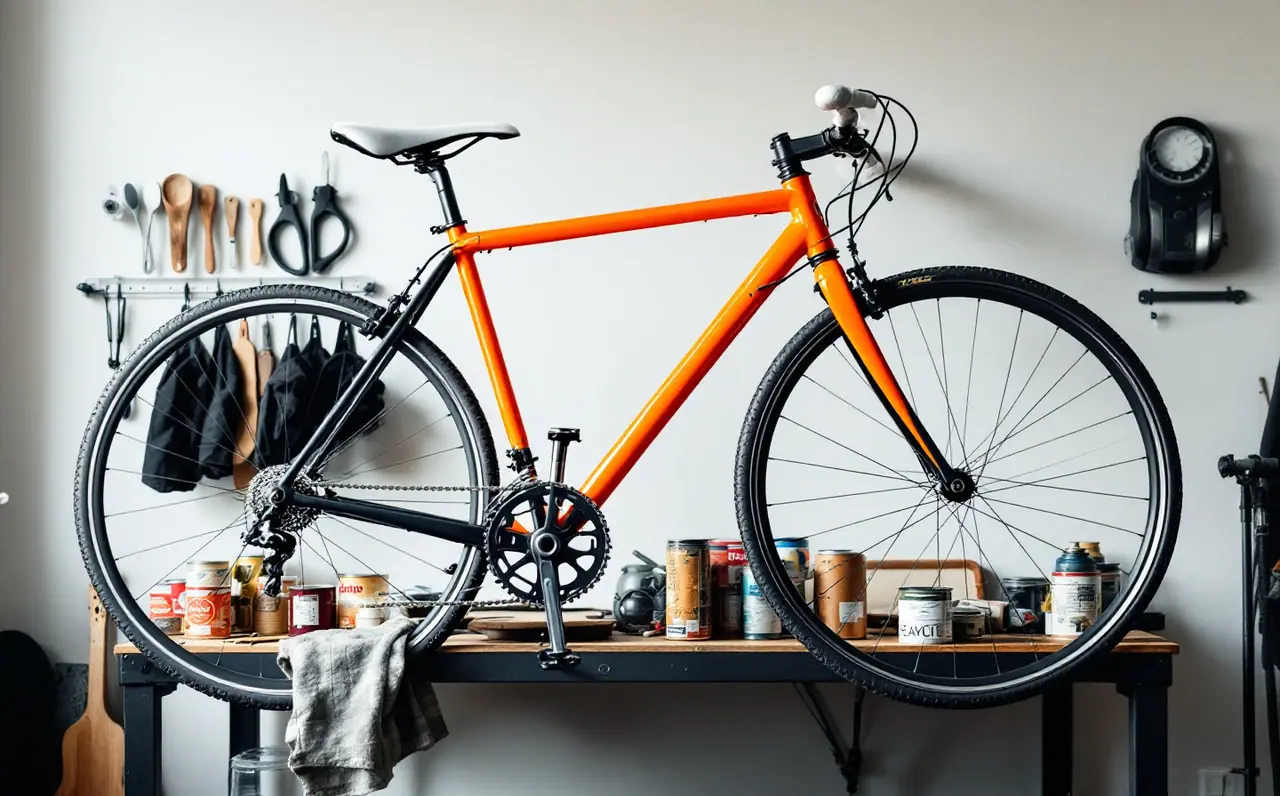
Every so often someone sends me a photo of a bike frame and asks why the luminous orange they sprayed looks nothing like the swatch they picked online. The honest answer is that the swatch never had a chance. The luminous shades in the RAL Classic range do something no ordinary paint, print or screen can do, and once you understand what that is, the odd behaviour of these colours on a screen, in the tin and on a frame all makes sense.
There are five of them: RAL 1026 luminous yellow, RAL 2005 luminous orange, RAL 2007 luminous bright orange, RAL 3024 luminous red and RAL 3026 luminous bright red. Each sits in the series for its colour family, so you will find them among the ordinary yellows, oranges and reds in a fan deck or on the chart. They do not behave like their neighbours.
What makes a colour luminous
An ordinary paint works by subtraction. White light falls on it, the pigment absorbs some wavelengths and reflects the rest, and the reflected part is the colour you see. A red paint absorbs most of the blue and green and sends back the red. The important limit is that an ordinary surface can never send back more light at a given wavelength than arrives at that wavelength. The best it can do is reflect all of it.
Fluorescent pigments break that limit in a particular way. They absorb light at shorter wavelengths, including ultraviolet, which we cannot see, and some violet and blue, and they give out part of that energy again as visible light at longer wavelengths: yellow, orange or red. So a luminous orange surface sends back the orange light that falls on it plus extra orange light made from light that was invisible or the wrong colour a moment before.
The result is a surface that looks brighter than its surroundings, as if it were lit from inside. It is most striking in the conditions that make ordinary colours look flat: overcast days, dusk, shade. Daylight contains plenty of ultraviolet, so luminous paint looks its most extreme outdoors. Under indoor lamps that give out little violet or ultraviolet light, the glow is weaker, though the colour is still very strong.
That brightness is the reason these shades exist. They are used where something has to be noticed: safety markings on machinery and steps, hazard edges, temporary marking on sites, hi-vis details on equipment, and on bikes, models and kit where the owner simply wants a colour that shouts. One caution on the safety side: painting something in a luminous RAL colour does not turn it into certified safety equipment. Hi-vis clothing and road signs follow their own standards.
Why a screen cannot show them
A screen makes colour from three coloured lights, red, green and blue, mixed in different amounts. The range of colours a standard screen can show, its gamut, is the set of mixtures those three lights can produce. For most screens and for most of the web, that range is described by the sRGB standard.
Luminous colours fall outside it in two ways at once.
- They are more saturated than the screen's primaries can reach at that lightness. A luminous orange is a purer, stronger orange than any mix of the screen's red and green lights.
- They look brighter than white surroundings. On a screen, the brightest thing possible is the screen's own white. A colour that seems to glow next to white paper has no place in a system where white is the ceiling.
When a luminous colour is converted to screen values, the conversion runs out of room and pins the result to the edge of the gamut. You can see it in the numbers. These are the approximate screen values used on this site:
| RAL colour | Approximate screen value | What the value tells you |
|---|---|---|
| RAL 1026 luminous yellow | #FFFF00 | Red and green both at maximum, blue at zero: the screen's strongest yellow |
| RAL 2005 luminous orange | #FF2300 | Red at maximum, almost no green |
| RAL 2007 luminous bright orange | #FFA421 | Red at maximum, a softer orange |
| RAL 3024 luminous red | #F70000 | Almost pure screen red |
| RAL 3026 luminous bright red | #FF0000 | Pure screen red, nothing left to give |
Values of FF and 00 are the screen running out of numbers. They mean "as far as this display can go", not "this is the colour". That is why the swatch on the RAL 1026 luminous yellow page looks like a highlighter on some displays and a slightly sickly lemon on others. It is a stand-in that helps you find the right shade in a list, and nothing more. The wider reasons screens and paint disagree are covered in why RAL colours look different on screen.
Print has the same problem. Ordinary four-colour printing cannot reproduce a fluorescent colour either, which is why printers use special fluorescent inks when a job really needs one. If you need to judge a luminous shade, a sprayed sample is the only reference that tells the truth.
They fade faster than ordinary colours
The other thing to know before you buy is that fluorescent pigments are less lightfast than ordinary ones. The same process that makes them glow wears them out. In strong sunlight they gradually lose their fluorescence and drift towards a paler, duller version of themselves, and the effect can be visible far sooner than with a conventional colour. Paint makers' data sheets for fluorescent products often say so plainly and recommend them for indoor use, short-term marking or use under a protective clear coat.
So plan for it. On a bike that lives in a shed and comes out at weekends, luminous paint can stay bright for a long time. On a gate post facing south, expect to repaint.
They need a white base coat
Luminous paints are fairly translucent. Much of their glow comes from light passing through the colour layer, bouncing off whatever is underneath and coming back out. Over a bright white, that bounce is strong and the colour glows. Over grey primer, bare metal or an old dark colour, the light is swallowed and the result looks muddy and weak.
The usual system is:
- A primer suited to the surface.
- A clean, bright white base coat, built up until it covers evenly.
- Several light coats of the luminous colour, building up gradually.
- A clear coat that the paint maker approves for use over its fluorescent paint, ideally one with ultraviolet protection.
A UV-protective clear coat slows the fading, though it will not stop it. Check compatibility carefully. Some clear coats can make fluorescent colours bleed, cloud or yellow, which is the opposite of what you want, so spray a test card with the full system before you touch the part.
How I would do it: a luminous orange fork on a black frame
Here is the kind of job that comes up in my shed: a 1990s mountain bike with a black frame, where the owner wants the fork and a band round the head tube in a luminous orange, the way plenty of bikes of that era came from the factory.
First, the colour. I would pick RAL 2005 luminous orange from a physical fan deck or, better, from a sprayed card from the paint supplier, never from a screen. RAL 2007 luminous bright orange is the softer alternative if the owner wants something a little closer to yellow.
Then the test card. Before any work on the bike, I spray a card with exactly the system I plan to use: primer, white, orange, clear. When it is dry I hold it next to the black frame outdoors, in daylight, and again indoors under the shed lights. That card tells me how many orange coats give the depth I want and whether the clear coat behaves.
On the parts themselves:
- Strip or sand the fork to a sound surface, degrease it and prime it.
- Mask the head tube band on the frame with good fine-line tape, pressing the edges down firmly so the white and orange do not creep under them.
- Spray the white base in light coats until it is even and bright, with no grey showing through. Let it dry as the can says.
- Spray the luminous orange in light passes, letting each one flash off. The colour grows stronger with each coat. Stop when it matches the test card, because piling on more can make it look heavier and less clean.
- Finish with the approved clear coat, again in light coats.
- Remove the masking tape once the paint is touch dry, pulling it back on itself at a low angle.
After that the advice is simple. Keep the bike out of strong sun when it is not being ridden, and keep the test card in a drawer as a reference. When the fork starts to look duller than the card, you will know it is fading, not your memory.
The short version
Luminous RAL colours glow because their pigments turn short-wavelength and invisible light into extra visible light. That makes them brighter and purer than anything an sRGB screen or ordinary print can show, so every swatch you see online, including RAL 3024 luminous red and its neighbours on this site, is only a placeholder at the edge of what the screen can do. In paint they need a white base, a careful clear coat and the expectation that they will fade sooner than ordinary colours. Judge them from a sprayed sample in daylight, and keep that sample for the day you need to touch up.
Saoirse Malone
Saoirse restores old bicycles and the occasional small motorbike in a shed outside Cork. She writes the spray and restoration guides, from frame colours to rattle-can technique in a cold garage.
More from the same drawer
RAL, NCS and Pantone: which colour system to use when
RAL, NCS and Pantone describe colour in different ways for different trades. Here is what each one is good at and why conversions are only ever nearest matches.
Read the note
How to read and use a RAL fan deck
What the strips in a RAL Classic fan deck tell you, how to hold one against a wall or a part, and how to store it so the colours stay worth trusting.
Read the note
Choosing a colour for a vintage bike frame restoration
Old bike frames wore their makers' own colours, not RAL. How to find the original shade, pick a RAL number a coater can use, and handle fluorescents and decals.
Read the note