
Powder coating gloss levels, from matt to high gloss
How powder coating gloss is measured, what matt, satin and gloss mean in gloss units, how sheen changes a RAL colour, and what to tell a coater before they quote.
 By Dieter Kaufmann7 minute read
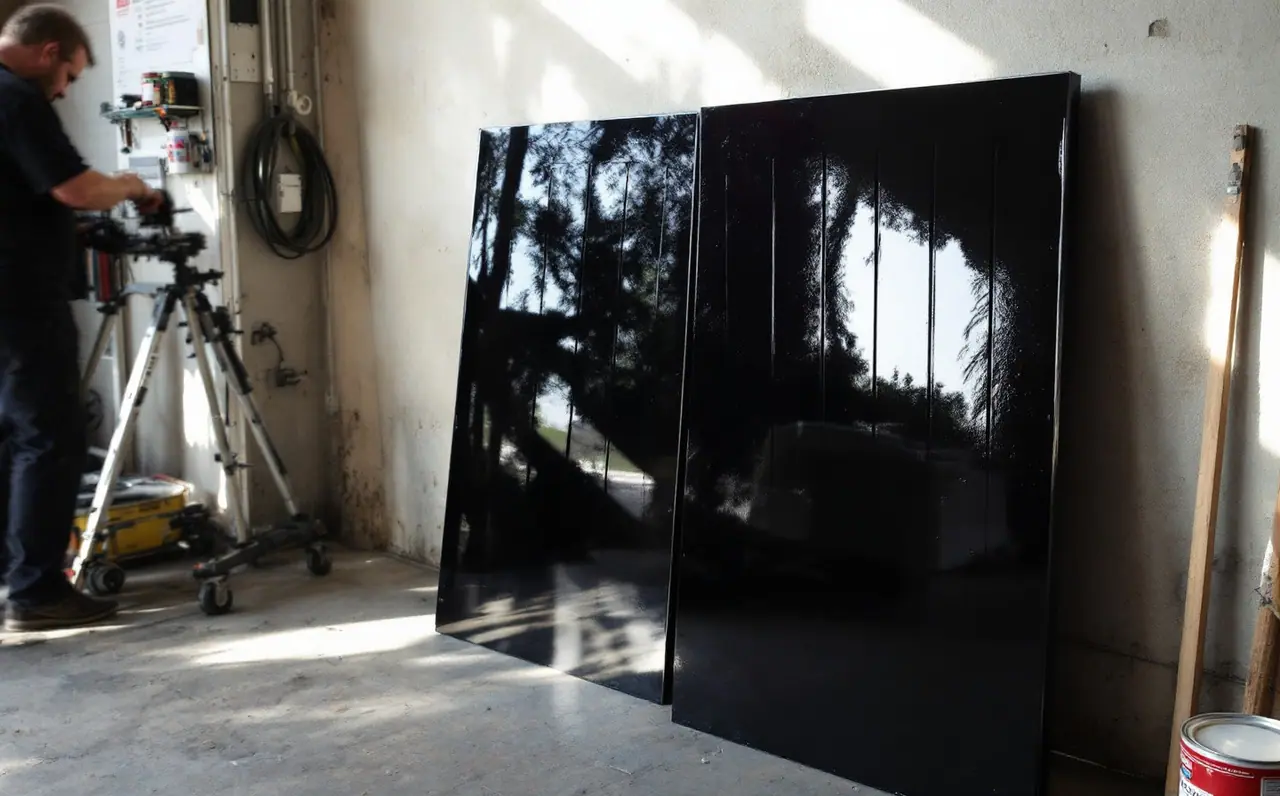
Ask a powder coater for "RAL 9005" and the first question back should be "what gloss?" If it is not, ask it yourself. The RAL number fixes the colour family, but the gloss level decides how that colour looks on the finished part, how it wears and how much of the metalwork underneath you can see through it. Two gates coated in the same black powder at different gloss levels can look like different colours from across a garden.
This guide covers how gloss is measured, what the usual names mean, how texture fits in, and the short list of things to tell a coater so the quote and the result match what you had in mind.
How gloss is measured
Gloss is measured with a glossmeter. It shines a beam of light at the surface at a fixed angle and measures how much bounces off at the mirror angle. The reading is in gloss units, usually written GU. A highly polished black glass reference sits at 100 GU on the usual scale, and most coatings fall somewhere between a few GU and the mid 90s.
The common measuring angle for coatings is 60 degrees, and that is the figure you will see on most powder data sheets. The standard methods also use 20 degrees for very glossy surfaces, where the 60 degree reading bunches up near the top, and 85 degrees for very matt ones, where the 60 degree reading bunches up near the bottom. When a data sheet just says "gloss 30", it almost always means 30 GU at 60 degrees, but check the sheet if you are comparing two products.
The loose bands
Manufacturers group gloss into named bands, and each maker draws the lines slightly differently. Treat the table below as a rough guide to how the names are commonly used, not a rule.
| Name you will hear | Roughly, at 60 degrees | How it looks |
|---|---|---|
| Matt, flat | under about 10 to 25 GU | Almost no reflection, a soft, chalky look |
| Semi-matt, satin, silk | about 25 to 50 GU | A gentle sheen, reflections blurred |
| Semi-gloss | about 50 to 70 GU | Clear sheen, reflections visible but soft |
| Gloss | about 70 to 90 GU | Shiny, reflections fairly sharp |
| High gloss | above about 90 GU | Mirror-like, like a car panel |
Two practical notes. First, "satin" and "semi-matt" mean different numbers to different makers, so ask for the GU figure rather than the name. Second, every powder has a tolerance on its stated gloss, often a few GU either way, so a 30 GU powder might come out a little above or below that on your part depending on film thickness, cure and the coater's oven.
How gloss changes a colour
This is the part most people do not expect. Gloss does not only change shine, it changes how dark and how saturated a colour looks.
A glossy surface reflects most of the light it does not absorb straight off at the mirror angle. If you are not standing at that angle, you see mainly the pigment, so the colour looks deep and rich. A matt surface scatters a little white light in every direction from the surface itself, which mixes with the pigment colour wherever you stand. The result is that matt colours look slightly lighter, greyer and less saturated than the same pigment in gloss.
With mid colours this is a subtle shift. With black and very dark colours it is obvious. A high gloss black looks like wet ink. A matt black looks charcoal, especially in bright daylight. Dark greys such as RAL 7016 go the same way, which is one reason anthracite window frames from two suppliers can look different even when both are sold under the same number; RAL 7016 anthracite grey on windows and doors goes into that in more detail.
Gloss also changes what you notice about the surface. High gloss shows every pit, weld ripple, grinding mark and bit of orange peel in the coating. Lower gloss hides much more.
Textures
Alongside smooth finishes, most powder makers offer textured versions.
- Fine texture: a slightly rough, even surface like fine sandpaper. It hides small marks in the metal, minor handling scratches and fingerprints, and it is a common choice for gates, railings, outdoor furniture and enclosures.
- Sand or structure finishes: coarser textures, sometimes called sand, ripple or wrinkle depending on the effect. They hide more and give a more industrial look.
- Effects such as hammer finishes or metallics: separate families with their own looks, often not tied to a single RAL number at all.
Textured powders usually have a low measured gloss, because the rough surface scatters light. A textured black at 30 GU will look different from a smooth black at 30 GU, so if you are matching existing work, match both gloss and texture.
Wear and cleaning
Each band has its own habits once the part is in use.
Gloss and semi-gloss coatings are generally easy to wipe clean, because dirt has less surface to hold on to. Scratches and scuffs show more readily, especially on dark colours.
Matt coatings hide scratches better at first glance, but some can polish up where they are rubbed often, such as around a gate latch or a handrail, leaving shinier patches. Dark matt finishes can also show greasy fingerprints. Follow the powder maker's cleaning advice: usually mild soap, water and a soft cloth, no abrasive pads, no strong solvents.
Textured finishes hide wear well but trap dirt in the texture. A soft brush with soapy water deals with that.
A worked example: a garden gate in RAL 9005
Say you have a steel garden gate, about 1 metre by 1.2 metres, with flat bar uprights, a few welded joints and some light pitting from years under old paint. You want it in RAL 9005 jet black, which this site shows on screen at about #131516, a neutral deep black. The coater offers two smooth exterior polyester powders: one at about 30 GU and one at about 80 GU.
At about 30 GU (semi-matt):
- The black reads as a soft, deep charcoal in daylight, and slightly blacker in shade.
- The welds and the remaining light pitting blend in. From a few metres away the gate looks even.
- Dust and pollen show a little less than on gloss.
- The latch area may polish slightly over years of hands.
At about 80 GU (gloss):
- The black looks deeper and blacker when you stand off the reflection angle.
- The sky, hedges and the house reflect in the bars, so on a bright day the gate shows streaks of grey and white highlight.
- Every weld ripple, grinding mark and remaining pit shows clearly. You would want the welds dressed smooth and the pitting filled or blasted before coating.
- It wipes clean easily but scratches are more visible.
For a working garden gate with honest welds I would choose the 30 GU powder, or a fine texture black if the pitting is more than light. For a decorative gate on a show-piece front garden, with the metal properly prepared, the 80 GU powder gives a more formal, lacquered look. Same RAL number, two quite different gates.
What to tell a coater
A short, clear request saves a lot of back and forth. This is the order I give it in.
- The colour: "RAL Classic 9005" (or whatever number), written down.
- The gloss: a number in GU at 60 degrees if you have one, or the band name with a rough figure ("satin, around 30 GU").
- The texture: smooth, fine texture, or a named structure finish.
- Interior or exterior: exterior parts need an exterior grade powder, usually a polyester or a more weather-resistant polyester. Epoxy powders are tough but tend to chalk and fade in sunlight, so they suit indoor parts and primers.
- The metal and its condition: steel, galvanised steel or aluminium, and whether it is bare, old paint, rusty or previously coated. Galvanised steel needs its own preparation, so say so.
- Preparation: ask what they plan (blasting, chemical pretreatment, a zinc-rich primer for exterior steel) and what that adds to the job.
- Matching: if it has to sit next to existing coated parts, bring one, or a photo of its label, and say so up front.
On cure, the coater will follow the powder maker's data sheet. Many sheets give something in the region of 180 to 200 °C for 10 to 20 minutes, but it varies, and under-curing affects gloss and durability, so it is their job to get right.
If you are tempted to coat small parts yourself with a hobby powder coating kit, the same choices about gloss and texture apply, plus two firm rules: use a dedicated oven that never goes near food, never the kitchen oven, and wear a suitable respirator when spraying powder. The powder coating section has more on preparation and on working with coaters.
The last thing to settle before you hand over the part is a test piece. Ask the coater to spray an offcut or a hidden bracket in the powder you have chosen, and look at it outdoors. Gloss is easier to judge on a real surface in daylight than on any number in a data sheet.
Dieter Kaufmann
Dieter has spent a lot of weekends around gates, trailers and garden furniture that needed stripping and coating. He covers powder coating, metal preparation and primers, and he is fussy about degreasing.