
Powder coatingDoors, windows and railings
Touching up chips on powder-coated gates
A chipped powder-coated gate can be touched up at home with wet paint ordered by RAL number and gloss. How to clean, feather and seal a chip before rust spreads.
 By Dieter Kaufmann8 minute read
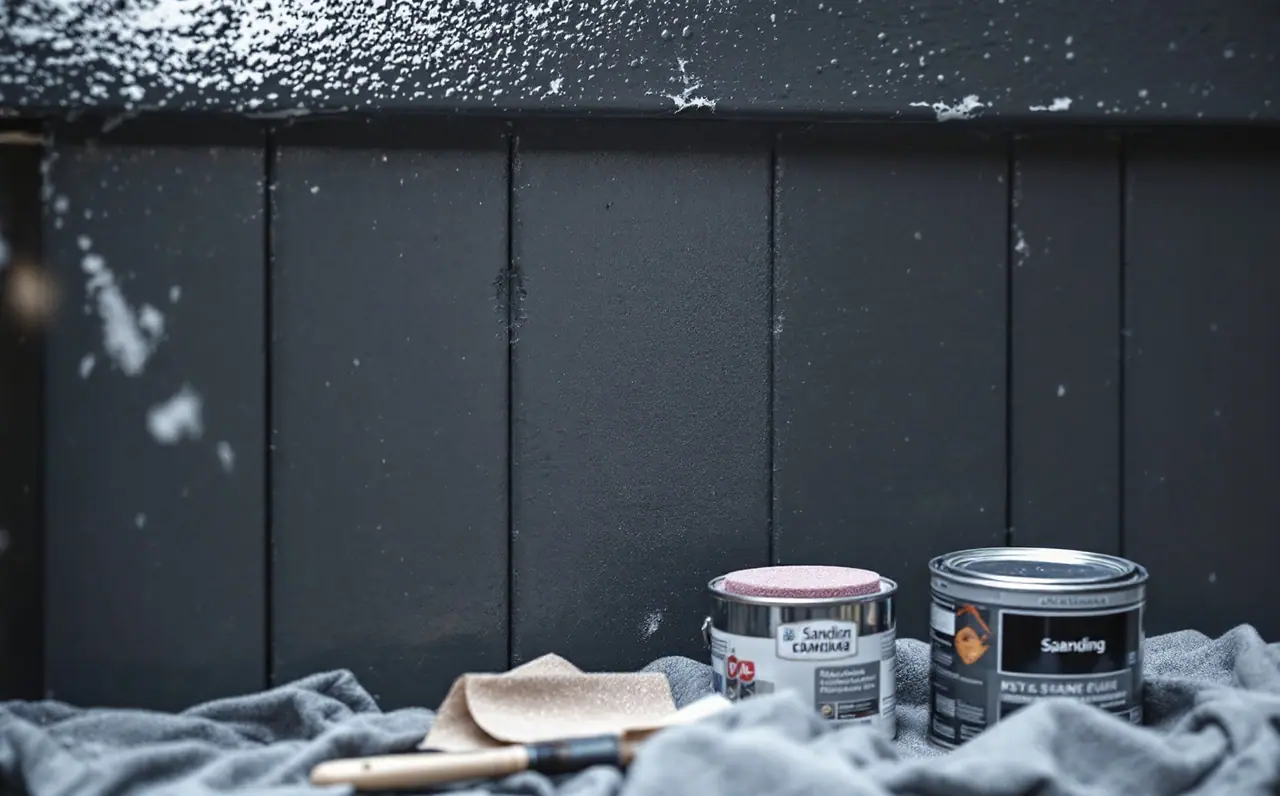
Powder-coated gates take a lot. They are swung into, leaned on, hit by bikes and wheelie bins, and they spend the whole winter wet. Sooner or later a chip appears, usually on a lower rail or near the latch where hands and boots meet the metal. A chip on its own is a cosmetic problem. Left through a wet November and a cold winter, it becomes a rust problem, and rust under powder coat does not stay where it started.
The good news is that a small chip is a straightforward repair with wet paint. The less good news is that it will never be invisible, and there is a point where touching up stops making sense. This is how I would approach it, in order.
Why you cannot patch powder with powder
Powder coating is applied as a dry powder, charged so it clings to earthed metal, and then cured in an oven. A common data sheet range is around 180 to 200 °C for 10 to 20 minutes, metal temperature, and each powder maker gives its own schedule. The whole part has to reach that temperature for the coating to flow and harden.
A gate cannot go back in an oven for one chip, and there is no safe way to heat a small patch to curing temperature at home. Heat guns and torches scorch the surrounding coating, cure the patch unevenly and leave a ring. So repairs on site are done with liquid paint. Powder makers and coaters often supply or recommend touch-up paints for exactly this reason.
What to order
Touch-up paint is ordered the same way as any other RAL paint, with two details people forget.
- The RAL number. If you do not know it, check the paperwork from the installer, or look on the gate's hinge side or the underside of a rail for a label. Many black and grey gates are RAL 9005 jet black, RAL 7016 anthracite grey or RAL 7021 black grey, but do not guess between them: they look similar until a patch sits next to the wrong one.
- The gloss level. Powder coats on gates are often matt, satin or semi-gloss, and a touch-up in the wrong gloss shows more than a small colour difference. Ask for the gloss band if you know it, or describe the finish. The background is in powder coating gloss levels explained.
- The texture, if there is one. Fine textured and sand-effect powders are common on gates and railings. A smooth touch-up on a textured finish will always read as a flat spot. Some suppliers sell textured touch-up paints; if not, keep the patch as small as possible.
For small chips a little bottle with a brush in the lid, or a small tin and a fine artist's brush, is plenty. Aerosols are useful for bigger areas but hard to control on a single chip, and overspray settles as a dull halo around it.
If you have a spare part from the same batch, such as an offcut or the inside face of a gate stop, use it to test the touch-up colour before you go near the visible rail.
The repair, step by step
1. Pick your day
Wet weather is the enemy here. Paint will not bond well to damp metal, and most touch-up paints list a minimum application temperature on the tin, often somewhere in the region of 5 to 10 °C, and ask for the surface to be above the dew point. In late autumn that means a dry spell, the middle of the day, and a gate that has had a few hours to dry off. If rain is forecast within a few hours, wait.
2. Clean the area
Wash the chip and a hand's width around it with warm water and a little detergent, rinse and let it dry. Then wipe with a solvent cleaner or degreaser suited to painted surfaces. Gates collect road film, garden sprays and greasy hand marks, and any of these will stop the touch-up sticking.
3. Deal with the bare metal
Look closely at the chip. If the metal underneath is bright and clean, you are in good time. If it is brown, flaky or there is a dark line spreading under the coating around it, rust has started and needs to come out.
Scrape or sand back to clean metal with a small piece of abrasive, around 120 to 180 grit, until you reach coating that is firmly stuck. Push a fingernail or a thin blade under the edge of the chip. If it lifts, keep going until it does not.
On galvanised gates, which many steel gates are under the powder, the metal may look dull grey rather than bright. That zinc layer is doing its job. Do not sand through it more than you need to.
4. Feather the edges
A chip leaves a sharp step between coating and metal. Lightly sand the edge of the surrounding powder with fine paper, around 320 to 400 grit, so the step becomes a gentle slope. Keep the sanded area small. The aim is for the touch-up to blend at the edge rather than sit as a raised blob, but every bit of powder you scuff is more area to cover.
5. Prime the bare spots
Bare steel needs an anti-corrosion primer before the topcoat; galvanised steel needs a primer that is made for zinc. Some touch-up kits include a primer, and some touch-up paints are sold as direct to metal, in which case the data sheet will say so. Prime only the bare metal, not the surrounding coating. For which shade of primer to use under a dark or a light topcoat, see which primer colour to use under a RAL topcoat.
6. Apply thin coats
Load the brush lightly and dab the paint into the chip rather than brushing it out. Two or three thin coats, with the drying time on the tin between them, build up better than one thick one, which tends to sag and shrink into a crater. Stop when the patch is level with the surrounding coating or very slightly proud.
7. Leave it alone
Touch-up paint needs time to harden, and cold weather slows that down. Avoid opening and closing the gate against the repaired area for a day or two, and keep hoses and pressure washers away for longer.
Rust creep under the coating
The reason to act quickly is something coaters call underfilm corrosion or rust creep. Once water reaches bare steel through a chip, rust forms at the edge of the coating and pushes underneath it. The powder coat stays intact on top for a while, so the gate looks fine, but the coating is gradually losing its grip. Eventually it lifts in a blister or flakes off in a sheet, and what was a 5 mm chip becomes a 50 mm patch.
Galvanised steel under powder slows this down a great deal, because the zinc corrodes in preference to the steel. Ungalvanised steel gates, older gates and gates with cut ends that were never sealed are the ones that suffer most.
You can spot creep by looking for:
- a thin brown or orange line around the edge of a chip;
- a raised, slightly soft area of coating near a chip or a weld;
- rust staining running down from a joint, a hinge or a bolt hole;
- coating that crackles or flakes when pressed.
Any of these means sanding back further than the visible chip, as in step 3.
Worked example: one chip, one evening plan
Say a gate in RAL 7016 anthracite grey, semi-gloss smooth finish, has a chip about the size of a little fingernail on the lower rail, with a faint brown line around it.
- Order a small touch-up bottle of RAL 7016 in semi-gloss, plus a small amount of a suitable primer for steel or galvanised steel, depending on what the gate is.
- Wait for a dry day. Clean and degrease at lunchtime.
- Sand out the rust until the coating edge no longer lifts. The bare area is now perhaps twice the size of the original chip.
- Feather the edge with fine paper. Wipe the dust off.
- Prime the bare metal. Let it dry as the tin says.
- Apply the first thin coat of RAL 7016. Second coat after the stated interval, a third the next dry day if needed.
From a couple of metres away the repair should disappear. Up close it will show a slightly different sheen and a faint edge, because wet paint and cured powder never look quite the same. That is normal.
When to have the gate recoated
Touch-up is for chips and small scrapes. There comes a point where the gate needs to go back to a coater, and the signs are fairly clear.
| What you see | Touch up | Recoat |
|---|---|---|
| A few small chips, clean metal | Yes | No |
| Chips with light rust, coating sound around them | Yes, sand back first | Not yet |
| Rust creep spreading under the coating in several places | Short term only | Yes |
| Blisters or sheets of coating lifting | No | Yes |
| Faded or chalky colour across the whole gate | No | Yes, if it bothers you |
| Many repairs already visible | No | Yes |
Recoating usually means the coater strips the old finish, often by blasting or a chemical or heat process, deals with the corrosion, and coats it again in the same or a new RAL colour. It is a bigger job, and the gate has to come off its hinges, but it resets the clock in a way that no touch-up can.
If you do have a gate recoated, ask the coater for a small bottle of matching touch-up in the same RAL number and gloss at the same time. The next chip will come, and it helps to have the right paint on the shelf before November.
Dieter Kaufmann
Dieter has spent a lot of weekends around gates, trailers and garden furniture that needed stripping and coating. He covers powder coating, metal preparation and primers, and he is fussy about degreasing.
More from the same drawer
Choosing a garage door colour that suits the house
Match the windows or contrast on purpose, test a big card outside, and check the door maker's RAL list before you commit to a garage door colour.
Read the note
Spray painting metal railings in a RAL colour
A practical guide to repainting steel railings in a RAL colour: weather, rust removal, degreasing, masking, primer, spray or brush, coats and paint quantities.
Read the note
Powder coating gloss levels, from matt to high gloss
How powder coating gloss is measured, what matt, satin and gloss mean in gloss units, how sheen changes a RAL colour, and what to tell a coater before they quote.
Read the note