
Choosing a garage door colour that suits the house
Match the windows or contrast on purpose, test a big card outside, and check the door maker's RAL list before you commit to a garage door colour.
 By Bram Visser9 minute read
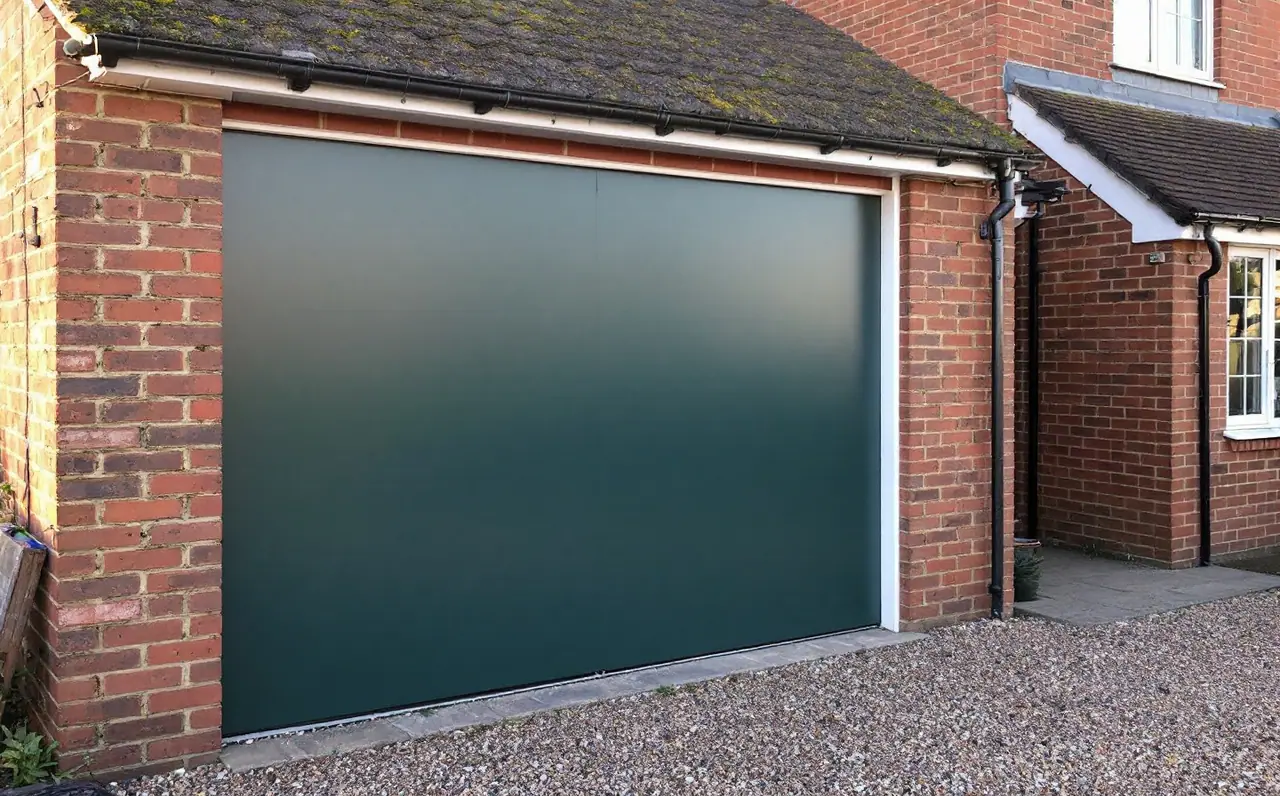
A garage door is usually the largest single painted surface on the front of a house. On a typical semi it is wider than the front door, the hall window and the porch put together, and it sits right beside the drive where everyone walks past it. Pick its colour from a chip the size of a postage stamp and it will surprise you, and not always kindly. This is how I would go about it: decide whether the door should match or contrast, test the colour at a size that tells the truth, then check what the door maker actually offers in the texture and finish you want.
Match or contrast, but decide on purpose
There are two honest ways to colour a garage door. The first is to let it join the family of colours already on the house: window frames, front door, fascias and gutters. The second is to make it a deliberate contrast that holds its own. Trouble lives in the middle ground, where the door is nearly the colour of the windows but not quite. The eye reads a near miss as a mistake, never as a choice.
Matching the windows
If the frames are white, a white door keeps the front calm and lets the brick do the talking. If the frames are dark grey, a door in the same RAL number pulls the house together in a way that "a similar grey" never manages. When you match, match the number, not the description. "Grey" from one supplier and "grey" from another can be miles apart, which is exactly why the four digits belong on the order form.
White deserves its own warning. White uPVC frames are not all the same white, and they can chalk or yellow slightly with age. Plenty of newer white frames sit close to RAL 9016 traffic white, but hold a real sample against your real frames before you assume it. If the frames are older and have gone a little creamy, a brilliant new white door beside them can make them look grubby overnight.
Contrasting on purpose
A contrasting door works best when it answers something else on the elevation. A dark door can echo a dark front door, a slate roof or black rainwater goods. A green door can pick up a hedge or painted railings. If nothing on the house relates to the door colour, the door looks as if it was delivered to the wrong address. A rule that rarely lets me down: keep the windows as the neutral constant, and make the front door and garage door either the same colour or clearly related.
If dark grey is on your list, the notes on RAL 7016 anthracite grey on windows and doors cover how that particular shade behaves next to brick, render and white trim.
A big flat panel changes the colour
Colour does not scale politely. The same paint on a large flat panel tends to read lighter and stronger than it does on a small sample. A grey looks paler and more silvery, a green looks greener, a muted red gets louder. Add outdoor daylight, which is far brighter than any shop's lighting, and the shift grows. The mid grey that looked serious and grown-up on the paint counter can look almost pale blue on a sunny south-facing door.
Some quick arithmetic shows why the chip misleads. A common single garage door is roughly 2.1 m by 2.1 m, about 4.4 square metres. A chip in a fan deck is a few square centimetres. An A3 sheet is about 0.125 square metres, so even a sheet of A3 is only around a thirty-fifth of the door. The chip is thousands of times smaller.
Test a large card outside
Paint the largest board you can manage, A2 or bigger, in each colour on your shortlist. Hardboard or thick card is fine. Give it two coats so the base does not show through. Then:
- prop the boards against the existing door, at the height the panels will be;
- look at them from the pavement or from across the road, because that is where the door is seen;
- check in the morning, at midday and in the evening, and on an overcast day if you can wait for one;
- look at them next to the window frames and the front door, not on their own.
If the new door will be factory coated, the paint on your board is a stand-in rather than the same coating. It still tells you how the hue and lightness sit against the house, which is the decision you are making at this stage. A physical RAL Classic fan deck is the better reference for comparing numbers side by side indoors, but it cannot replace the board outside.
What door makers offer
Makers of sectional and roller doors commonly list a range of standard colours, and many give RAL numbers for them. Some offer a much wider choice of RAL colours as a special order, often with a longer wait. The details vary by maker and by model, so check the maker's own list for:
- which RAL numbers are available for the exact door model you want;
- which surface textures each colour comes in;
- the gloss level, which is often a satin or silk sheen on steel panels;
- whether the inside face is the same colour or a standard white or grey.
A RAL number on a garage door brochure is a target colour, applied in that maker's coating. Factory coil-coated steel, powder-coated aluminium and foil-wrapped panels can all carry the same RAL number and still look slightly different from each other and from your window frames. Ask for a physical sample of the door finish if the maker offers one. A brochure photo or a screen swatch is an approximation and nothing more.
Popular choices and how they behave
RAL 7016 anthracite grey
The default modern dark grey, with a faint blue-green lean. On a big door it reads lighter than people expect, more slate than charcoal. It pairs well with grey windows, buff brick and render. The RAL 7016 anthracite grey page has the screen approximation, which will look darker on most monitors than it does on a sunlit door. It shows dust, pollen and dried water spots more than mid tones do.
RAL 9016 traffic white
A clean, bright white that suits white frames and pale render. Road splash and leaf stains show on the bottom panels, so expect to wash it more often than a darker door.
RAL 9006 white aluminium
A metallic silver. It looks lively in sun and flatter under cloud, and it hides dirt well. Because it is metallic, small repairs are harder to blend, since the flakes in a touch-up rarely lie the same way as the factory coat. The RAL 9006 white aluminium swatch on a screen cannot show the metallic effect at all; look at a real sample.
RAL 6005 moss green
A deep, traditional green that goes almost black in shade and turns properly green in low sun. It sits very well with red brick, hedges and timber, and it is a good choice when you want a door to recede rather than shout.
RAL 8019 grey brown
A dark, warm brown with grey in it. Softer than anthracite on a warm brick house, and kind to houses with timber details or brown roof tiles. It can look plain on a pale rendered house.
Dark colours and heat
Dark colours absorb more of the sun's heat than light ones, and a dark steel door in full afternoon sun gets noticeably hotter than a white one. That heat makes panels expand, and on some door types it can lead to bowing, stressed seals or problems with foam-filled panels and foil finishes. For this reason some makers restrict the darkest shades on certain models, or attach conditions when a dark door faces south or west.
Follow the maker's guidance on dark shades. If your door faces the afternoon sun, ask the question before you order, and get the answer in writing. The same applies to repainting: turning a white door dark grey with a tin of paint can change what the maker's warranty covers.
Woodgrain or smooth
Steel sectional panels are often offered with an embossed woodgrain, a fine sand-like texture, or a smooth face. Texture breaks up reflections, so the same RAL number tends to look a touch darker and softer on woodgrain than on a smooth panel. Woodgrain also hides small dents and fingerprints. Smooth panels look crisper and more modern, but they show every ripple in low sun.
If your windows are smooth aluminium and the door is woodgrain steel, accept that the two will read slightly differently even in the same RAL number. That is texture doing its job, not a mismatch.
Repainting an existing steel door versus ordering a new colour
If the current door is sound and only the colour is wrong, repainting is a reasonable job. Check the maker's warranty terms first. A sensible order of work:
- Wash the door with a degreasing cleaner, rinse well and let it dry completely.
- Scuff the factory finish lightly with an abrasive pad so the new paint has something to grip.
- Spot prime any bare metal or rust with a primer suitable for steel; where the bare metal is galvanised, use a primer made for zinc.
- Mask the seals, rubbers, handles and windows. Keep paint off the springs, cables, rollers and tracks, and never loosen the springs, which are under tension.
- Apply two coats of an exterior metal paint tinted to your RAL number, following the tin for drying and recoat times.
For quantities, work from the tin. If it quotes 10 square metres per litre and the outer face is about 4.4 square metres, two coats come to about 9 square metres, so a litre will just about cover it on a smooth door. Embossed woodgrain holds more paint, so I would allow for a litre and a half.
Ordering a new door in the colour you want costs more but gives you a factory coating that is applied evenly, cured properly and covered by the maker for that colour. If the old door is dented, draughty or near the end of its life, that is usually the better route.
Worked example: a 1930s brick semi with white frames
Picture a 1930s semi in red-brown brick with white uPVC windows, a white front door, a hipped tiled roof and a single garage at the side. The old up-and-over door is being replaced with a steel sectional door, woodgrain finish, facing south-west.
The shortlist I would paint on boards:
- RAL 9016 traffic white, to sit with the frames and front door;
- RAL 7016 anthracite grey, as a modern contrast;
- RAL 6005 moss green, a period-friendly contrast with red brick;
- RAL 8019 grey brown, to pick up the darker bricks.
Propped against the old door and seen from across the road, the anthracite grey would probably look heavy, because nothing else on this house is dark. It would work if the front door went grey too. The grey brown might blend so well that the door disappears into the brickwork, which some people want and others find dull. The white is the safe match, as long as the board sits happily beside the actual frames.
The moss green is the one I would lean towards, on one condition: the front door gets repainted in the same RAL 6005, so the two doors are a pair and the white frames stay the constant. Because the door faces south-west, I would check the maker's guidance on dark shades for that model before ordering. If the answer is a restriction, the white door with a green front door is a good fallback.
Whatever you choose, write the RAL number, the texture, the gloss level and the door model on the order, and keep the best test board in the garage. It is the most useful reference you will have when the front door needs repainting in ten years' time.
Bram Visser
Bram writes about colour on the outside of houses: front doors, window frames, garage doors, fences and railings. He has repainted more Rotterdam doorways for friends than he likes to admit.
More from the same drawer
Spray painting metal railings in a RAL colour
A practical guide to repainting steel railings in a RAL colour: weather, rust removal, degreasing, masking, primer, spray or brush, coats and paint quantities.
Read the note
RAL 7016 anthracite grey on windows and doors
Why RAL 7016 anthracite grey ended up on so many window frames and doors, how it behaves in daylight, what it pairs with and when a neighbouring grey suits better.
Read the note