
Why car paint codes are not RAL codes
Car makers use their own paint codes and layered formulas, so a RAL number is only ever a nearest flat shade. When RAL helps, and why touch-up goes by the car's code.
 By Saoirse Malone7 minute read
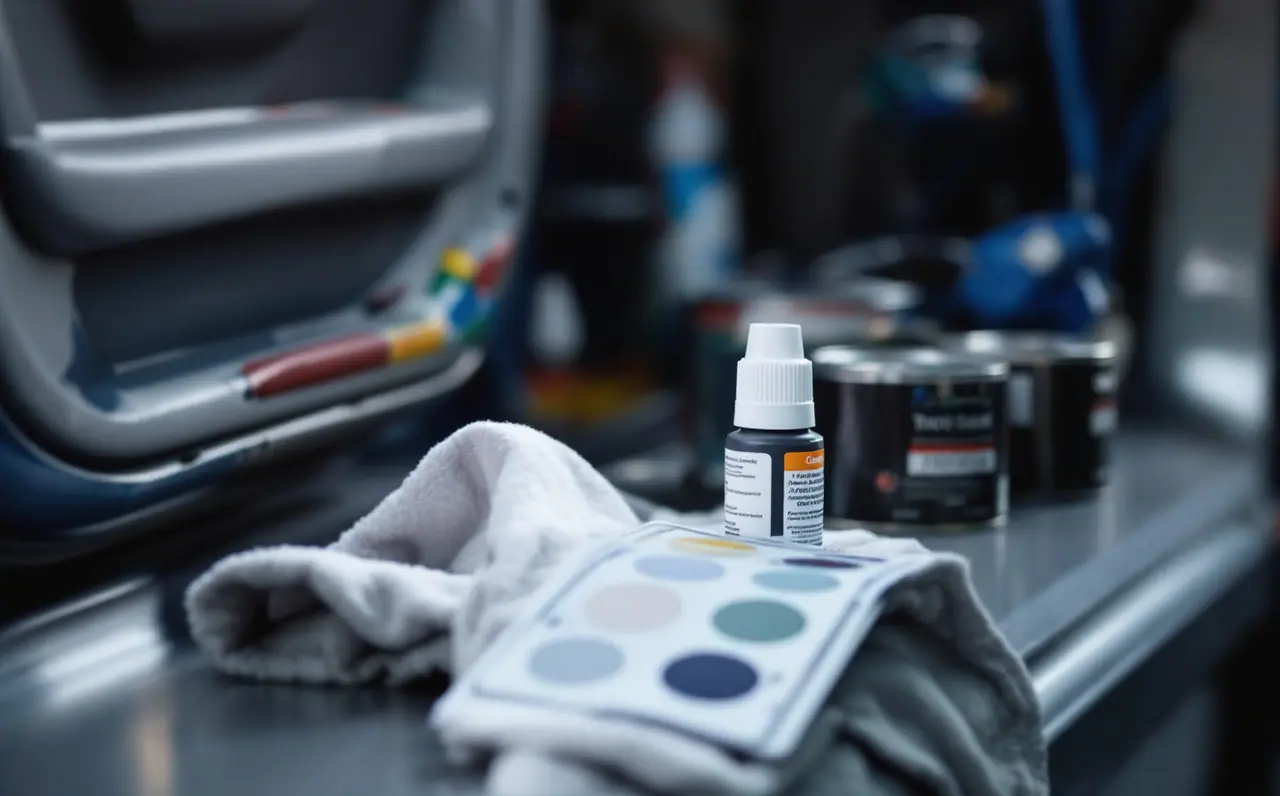
A surprising number of questions that reach a RAL colour reference are really about cars. Someone has a red hatchback and wants to know which RAL red it is. Someone wants a trailer to match the van. Someone has a scrape on a bumper and a spray can in RAL 9006 and is wondering whether it will do. The honest answer in almost every case is that a car's colour is not a RAL colour, and treating it as one leads to patches that look wrong from every angle.
This is a question and answer piece, because the same handful of questions come up again and again.
Questions readers ask
Is my car painted in a RAL colour?
Almost certainly not. Car makers develop their own colours, give them their own names and codes, and publish formulas for them through the refinish paint companies. A maker's red has a code that means something in that maker's system and in refinish mixing software. It does not correspond to any RAL Classic number, even if the two look similar on a screen.
There are exceptions. Some commercial vehicles are painted to a fleet colour after leaving the factory, and some special builds, emergency or utility vehicles and agricultural machines are finished in RAL shades. But an ordinary passenger car in a showroom colour is not one of them.
Why can't someone just tell me the nearest RAL number?
They can, and a match tool will happily give you one. The problem is what "nearest" means. RAL Classic is a range of roughly 200 mostly solid colours spread across the whole colour range. Car makers produce thousands of colours over the years, many of them within a small distance of each other, and each one is tuned to a particular look. The nearest RAL shade to a given car colour is often clearly different when the two are painted side by side.
On top of that, most car colours are not solid.
What makes car paint so different?
Three things, mainly.
First, effects. A large share of modern car colours are metallic or pearl. Metallic paints contain aluminium flakes that reflect light like tiny mirrors; pearl paints use coated mica or similar effect pigments that shift colour slightly with angle. Both change appearance as you walk around the car: brighter face on, darker or a different hue at a steep angle. That change is called flop, and two paints with the same colour face on can have very different flop.
Second, layers. A typical modern car finish is built from a primer, a coloured basecoat and a clear coat on top. Some colours add a tinted mid coat between the base and the clear for depth, which is often called a three-stage or tri-coat finish. The colour you see comes from all of those layers together.
Third, the formula itself. Refinish suppliers mix a car colour from a published recipe for that maker's code, often with variants for different factories or production periods, because the same named colour can drift slightly over a car's production run.
A RAL number, by contrast, names one flat colour in a sample book. Even the RAL pearl and metallic shades are a small handful of fixed colours, not a system for reproducing any particular flake effect.
What about RAL 9006 for silver wheels and trim?
RAL 9006 white aluminium is a metallic shade and is widely used on gates, railings, radiators and machinery. It is a reasonable choice if you are refinishing a whole part in a silver of your own choosing, such as a set of steel wheels on a trailer. It is not a match for the silver on a particular car's wheels or bodywork, which will have its own maker's code and effect.
Finding the paint code
On most cars there is a label or small plate with the paint code printed on it. Common places are the door jamb or pillar on the driver's or passenger side, under the bonnet near the front panel or a suspension turret, in the boot or the spare wheel well, and sometimes in the service book or the original paperwork. The code may be letters, numbers or both, and it is sometimes labelled "paint", "colour" or by an abbreviation. Every maker does it a little differently, so if you cannot find it, a dealer or a motor factor can usually look it up from the vehicle details.
Touching up by the car's code
Go by the car's paint code, not by RAL. Give the code to a refinish supplier or motor factor and they can mix basecoat or touch-up paint to that formula, with the right clear coat to go over it. For small stone chips a touch-up bottle with a brush is the usual answer. For a larger area, a supplier can fill aerosols, or a body shop will mix and spray the colour properly.
Even with the right code there is often a small difference between a new mix and paint that has been outdoors for years. That is why body shops blend repairs into the panels next to them rather than painting exactly up to an edge. A RAL colour would add a much bigger difference on top of that, and no amount of blending hides a metallic patch in a solid colour, or the reverse.
When RAL is the right system
None of this means RAL has no place near vehicles. It is a very good system whenever the colour is yours to choose and you are painting a whole part, rather than matching a maker's finish.
- Trailers, horse boxes and towing frames, which are often painted or powder coated in RAL shades.
- Vans and work vehicles painted to a company colour, where the business has chosen a RAL number for its signage, premises and vehicles.
- Farm and plant machinery. Many machinery makers use solid colours and owners often repaint in a RAL shade that is close to the original.
- Custom solid colours on project cars, motorbikes and bicycles, where you want a colour you can name and reorder.
- Chassis parts, brackets, roll cages and engine bay parts that are commonly finished in black, grey or silver.
In all of these, the whole surface is the same colour, so there is nothing to match against. The RAL number is the specification.
Worked example: a trailer to go with a red van
Say a business has a solid red van, and it wants a new box trailer that looks like it belongs to the same fleet.
The van's maker has its own code for the red, so the most faithful route is to ask the trailer builder or coater whether they can mix to that code. Some can, especially if the trailer is wet sprayed. Many trailer and box builders work in RAL colours or powder coat, though, and will ask for a RAL number.
In that case I would get the van's paint code first, ask a supplier for a painted card or a small sample of it, and then compare that card with a few RAL reds side by side in daylight. Candidates for a strong, clean red might include RAL 3020 traffic red and RAL 3000 flame red, with RAL 3002 carmine red as a darker option. You can also enter an approximate hex value for the van's red in the Match Lab to see which RAL reds sit closest on screen, then order cards of those.
The trailer will not look identical to the van, and nobody should promise that it will. But a well chosen solid red in the same gloss, parked next to the van, reads as part of the same set. A trailer that is a metallic red, or a red with a noticeably different lean towards orange or blue, will not.
A note on safety
Most car refinish clear coats and many basecoat systems are two-pack (2K) products that contain isocyanates. They need proper respiratory protection, which usually means air-fed equipment in a spray booth, and they are not for a home garage without it. Some single-pack aerosols are sold for small repairs; read the label and the safety data sheet, ventilate well and wear a suitable paint respirator at the very least. If the paint you are offered is 2K and you do not have the setup for it, a body shop is the safer route.
The rule to keep
If you are repairing a car, use the car's code. If you are choosing a colour for something new and solid, use a RAL number. Trouble starts only when someone tries to make one system do the job of the other, and no paint counter can fix that after the event. For more on what to bring to the counter when you do order by RAL, see matching a RAL number at the paint counter.
Saoirse Malone
Saoirse restores old bicycles and the occasional small motorbike in a shed outside Cork. She writes the spray and restoration guides, from frame colours to rattle-can technique in a cold garage.
More from the same drawer
Luminous RAL colours and why screens cannot show them
The five luminous RAL Classic shades glow because their pigments turn invisible light into colour. Here is why no screen can show them and how to paint them.
Read the note
Choosing a colour for a vintage bike frame restoration
Old bike frames wore their makers' own colours, not RAL. How to find the original shade, pick a RAL number a coater can use, and handle fluorescents and decals.
Read the note